
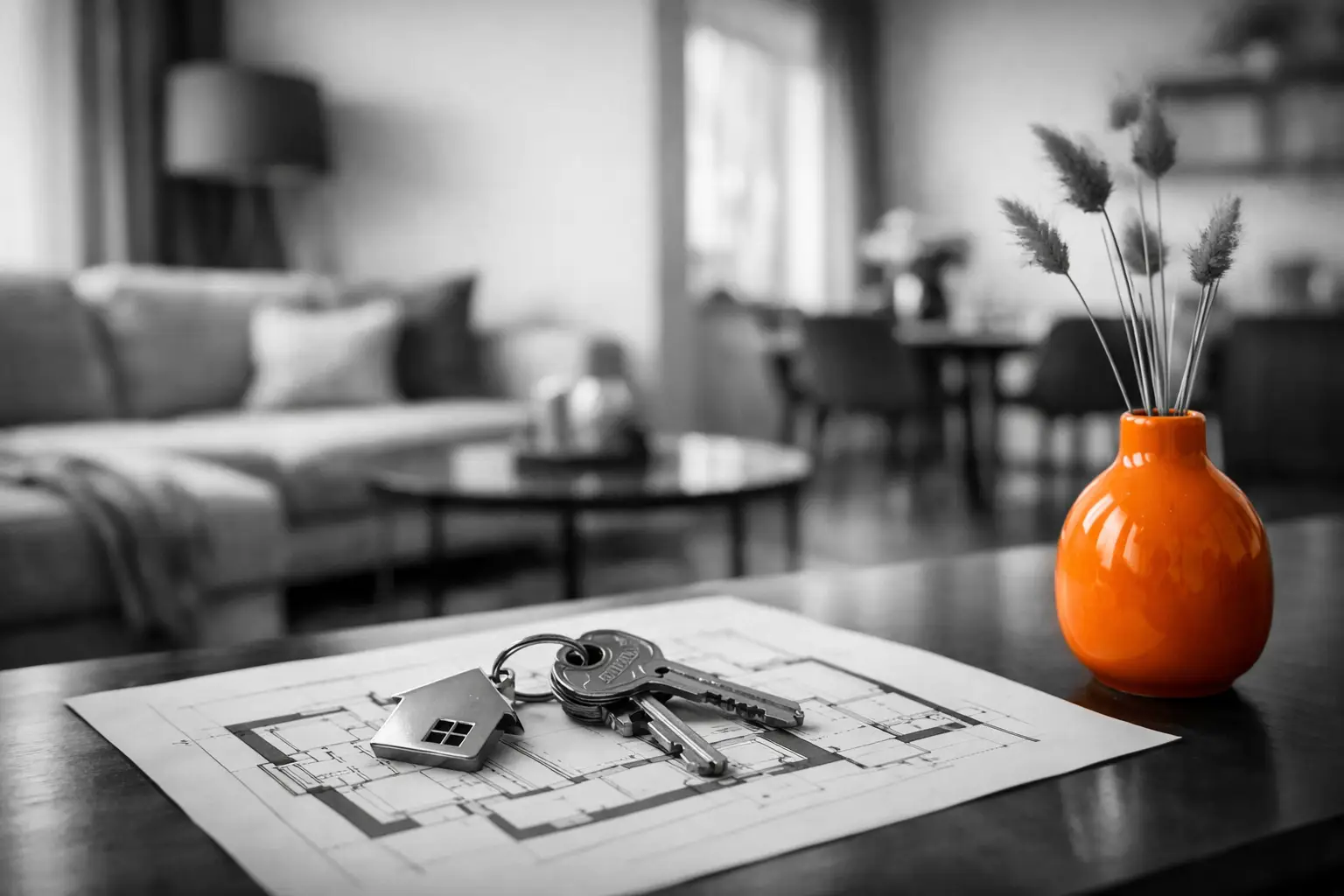
A first viewing often decides the fate of an apartment sale before the buyer even asks about the price. This isn't because they are looking for a perfect interior, but because they are spending those few minutes evaluating whether they can imagine their own life in the space. Home staging is therefore not just about decorating. It is a controlled preparation process intended to remove unnecessary doubts and make the layout, natural light, and living potential of the property clearer.
This is especially important when the sale is a stepping stone to another phase: a family needs to unlock funds for a larger home, heirs are handling an apartment after their parents, or former partners need to agree on the sale of a shared property. In such situations, you don't want to worry about every vase and chair individually. You need to know what truly helps the sale, what is an unnecessary expense, and the right order for the next steps.
What home staging should change
Properly executed home staging should not hide defects or create an impression that doesn't reflect reality. Its role is to highlight the possibilities of how the space can be used. Buyers should immediately recognize where the dining table will go, where a home office fits, whether the bedroom provides privacy, and how daily operations flow.
An empty apartment may look larger, but it can also feel cold and harder to interpret. Conversely, a unit packed with personal items, redundant furniture, or dozens of small objects can seem smaller than it actually is. Home staging finds a sensible middle ground. Sometimes decluttering is enough; other times, adding essential furnishings for photography and viewings is appropriate.
It is important to distinguish between preparation for presentation and full-scale renovation. A new kitchen before a sale may not return your investment, especially if the future buyer intends to renovate it to their own taste anyway. However, fixing a loose socket, replacing graying silicone sealant, or unifying lighting can eliminate the feeling of a neglected property. The scope depends on the state of the apartment, the pricing strategy, and the expected buyer profile.
Sales plan first, modifications second
A common mistake occurs when an owner starts preparing the apartment without answering basic questions: How quickly does the property need to be sold? Who is likely to be interested? Is the goal to sell with furniture or empty? And what documents or property rights might affect the timeline?
For an inherited apartment, the priority may be the sensitive sorting of personal items, settling probate, and ensuring access to building documentation. Only then does it make sense to address presentation. For a family buying a larger home and needing to coordinate dates, preparation must account for the fact that they are still living in the unit for several weeks. Staging cannot require everyday sterile perfection or moving out half the household without a backup plan.
When managing divorce or co-ownership settlement, it is useful to agree on a budget for necessary repairs, the decision-making process, and viewing availability in advance. Even a well-prepared presentation loses value if viewings are cancelled, if each co-owner gives buyers different information, or if legal documents are missing.
At DREEM, apartment preparation is part of a broader procedure. It does not start with a list of decorations, but with an evaluation of the initial situation, pricing, timeline, and what the sale truly requires. The owner then knows exactly what is happening and what comes next, rather than coordinating photographers, cleaning, buyers, and documents as a full-time project.
When improvements usually pay off
Improvements that enhance spatial clarity, light, and the overall impression of care are particularly worthwhile. These often include professional cleaning, removing excess furniture, clearing hallways and storage units, minor repairs, or unifying colors and lighting. For photography and viewings, it helps if work surfaces are clear, the bathroom doesn't look like a cosmetics warehouse, and the balcony isn't a storage area for clutter.
In some apartments, partial furnishing makes sense. Typically, where an empty living room makes it difficult to judge the size of the room, or where a smaller second room might be perceived only as a storage closet. Appropriate furniture shows it can serve as a child's room, study, or bedroom. However, there is no need to create a catalog-style interior. In Prague and its surroundings, not only does the state of individual apartments vary, but buyer expectations also differ based on location, layout, and price point.
Caution is advised regarding larger investments. If plumbing is at the end of its lifespan, the bathroom requires a complete overhaul, or the building is awaiting major structural repairs, it is not honest to hide these facts with new textiles. It is better to describe the state clearly, factor it into your pricing and negotiation strategy, and prepare documents that help the buyer evaluate the situation.
How to recognize that an apartment needs less than you think
Owners are often accustomed to their own home. They may not see the wardrobe in the hallway that narrows the walkway, nor the cracked light switch cover, because they have lived with them for years. Conversely, they might overestimate items that won't bother a buyer, such as an older but well-maintained floor or a kitchen from the previous decade.
It helps to view the apartment through the eyes of someone who has never been there before. From the front door, through every room, to the cellar, balcony, and common areas. Ask yourself whether the purpose of the room is obvious, if it is possible to walk through comfortably, where the natural light falls, and if anything raises a question you aren't prepared to answer.
Time is also a practical factor. When you need to sell due to an upcoming payment deadline, settlement, or subsequent purchase, a long renovation can complicate the situation. Shorter, precisely defined preparation is safer than trying to change an apartment beyond recognition within a few weeks. Every decision should improve the sales process, not add further uncertainty.
Presentation must match the reality
Home staging only works if the photographs, description, and personal visit tell the same story. A buyer should not arrive only to find that the photographed rooms were staged for just an hour, or that an important part of the layout is missing from the pictures. Trust is built on small details: the current state of the apartment, accurate information about costs, clearly explained restrictions, and prepared documentation.
This also applies to an occupied apartment. If a family remains in the home during the sale, it is better to set a realistic viewing regime and determine in advance what will be adjusted before every visit. This doesn't mean maintaining hotel-like perfection. A simple routine is enough: clear away personal items, free up surfaces, air out the space, turn on lights, and remove anything that distracts from the space itself.
Decisions that help you stay in control
Home staging is not a requirement, nor is it a universal recipe for a higher price. A well-maintained apartment might only need minor preparation. For a property that has been used for many years or has failed to attract interest, a change in presentation can help clarify its value to the right buyers.
It is most useful to view it as one decision within your overall sales plan. When you know in advance what will be updated, what it will cost, who will handle it, and how the preparation connects to pricing, photography, viewings, and legal steps, the apartment doesn't just look better—the entire sale becomes more transparent and easier to manage.
All articles